
Chevron Wheatstone LNG Construction Workcamp
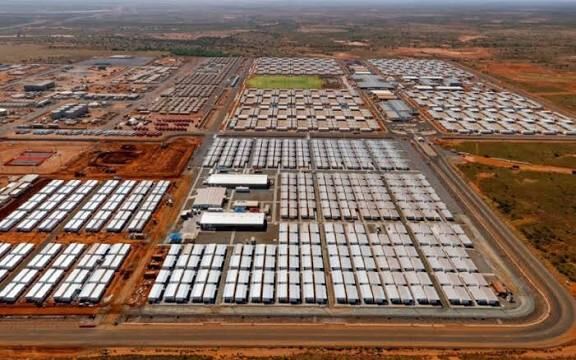
A 3,800-room construction village near Onslow, Western Australia, with its own power station. Energy strategy written in 2011.
Measured, supply count
Modelled, 2011 design review
Reported
Figures from named sites, before solar. Results vary by site.
A town that has to generate every kilowatt it uses
A construction village in the Pilbara has no grid to lean on. It generates its own electricity, so peak demand does not just set a tariff: it sets how much generating plant has to be shipped in, built, fuelled and maintained for the life of the construction programme. Accommodation air conditioning is the largest single driver of that peak, and it runs in rooms that are empty for most of the working day.
The brief was therefore not a retrofit. It was to design the demand down before the power station was sized, so the camp could be built around a smaller load.
A design load, not a meter reading
The baseline for this engagement is the camp's design case: a modelled peak demand of 11.7 MW and a power-station capacity of 18 MW. Because the village did not yet exist, the comparison on this page is between two designs rather than between two metered periods, and it is labelled that way throughout.
One controller in every room
Our team supplied 3,800 Climate Controllers, one per accommodation room.
The Climate Controller was reported to cut room air-conditioning energy by 55% with an 18-month payback.
The rest of the work was design rather than equipment: an energy efficiency design review that set the demand assumptions for the village and the power station that had to serve it.
The village model, in two rows
| Measure | Before | After | Proof label |
|---|---|---|---|
| Peak demand | 11.7 MW | 5.5 MW, a fall of 53% | Modelled, 2011 design review |
| Power-station capacity | 18 MW | 9.6 MW | Modelled, 2011 design review |
These two rows are the whole of the published village model. The design review's other rows are not published, because a business-case output is not a measured result and the ones that remain have no independent record behind them.
Measurement methodology
Three different kinds of number appear on this page and they are kept apart. The controller count is a supply count from the project record. The room air-conditioning saving and its payback are reported by the Climate Controller material and have not been independently verified. The peak-demand and power-station rows are outputs of the 2011 energy efficiency design review: predictive business-case figures produced before construction, not measurement and verification results.
How comparable work is funded
This engagement predates the structure below. It is how Enspara funds comparable work now.
No upfront capital. Approved measures can be funded through a Finance Partner and repaid from verified savings, so a share of the saving stays with you from the first month. Subject to design, credit approval and verified savings. Any finance solution is provided under a separate customer agreement with a Finance Partner and remains subject to credit approval.
Eighteen months on the air-conditioning solution
The Climate Controller was reported to cut room air-conditioning energy by 55% with an 18-month payback. A return on investment of 36% is also reported for the air-conditioning solution. That figure is a return on investment and is not a payback period. Both are reported by the Climate Controller material rather than measured on site.
Your Operation Keeps Running
Installed outside service hours. Local override on every system. No extra work for your staff. The full commitments
Prove it at two of your own sites
Send the bills for two sites. We come back with the case.
What sits behind these numbers
The records behind this page are our team's 2011 energy efficiency design review for the village and the Climate Controller material. The village figures are predictive design outputs, not measurement and verification results, and they are labelled modelled wherever they appear. The air-conditioning saving, the payback and the return on investment are reported by the Climate Controller material. No dollar figure from this engagement is published. Chevron Wheatstone is named as the project; the construction contractor is not.
Results for another site will differ.
Delivered by the Enspara team in 2011, before Enspara was founded in 2026.